Sabtu, 27 September 2014

Are you a design rebel?


What's your first instinct if someone tells says you shouldn't do something?

Do you automatically want to do it?  I do! 

 Most people would agree that there are rules/guidelines in interior design. They impact decisions about all sorts of things,  e.g.,  hanging lights, choosing the right scale furniture, selecting colour schemes, etc.   I guess following them is a little like following a recipe - you get a predictable result. Someone else has done all the thinking for you which makes it easy but, you also get a very generic looking space where everything looks controlled.

 I always think about those generic spaces  as the "Pinterest look" . You know  the rooms, all  beautifully organized, cutely accessorized with whatever is trendy at the time, and perfectly matched.   Does that make them wrong?  Definitely not.  I firmly believe we should all live in spaces that make us happy and comfortable.   What I am saying is that there are options in design that produce interesting, one of a kind spaces that are  usually achieved by playing around with design elements and principles. They are not for everyone.

 Take the room below.....

 breaking design rules, scale,
source

  Have a close look at this space  and decide what you like or don't like about it.  Check out my thoughts  at the end of this post. There are no right or wrong answers.

 How closely you adhere to rules is dependent on what results you want to achieve, how well you understand the elements/ principles  of design,  and how creative you are at applying them.  You can do anything in decorating, you just need to act bravely, and figure out how to pull it off.  But, before you can break the rules you have to know them.

Can you spot which  rules/guidelines were  thrown to the four winds in these rooms? 

1.
 breaking design rules, mixing styles, modern and traditional,
 source

 breaking design rules, mixing styles, modern, traditional
source


2.
 mixing metals, breaking design rules
source

 mixing metals, breaking design rules
source

 3.

breaking design rules, scale, accessories
 source

 breaking design rules, scale


4.

breaking design rules, monochromatic schemes, neutral schemes
 source

 breaking design rules, neutral spaces, monochromatic schemes

source

5.

breaking design rules, mixing wood tones,
 source

 breaking design rules, mixing wood tones
source


6.


breaking design rules, dark walls, small spaces


breaking design rules, small spaces, bright colours


Here are the results: 

breaking design rules, mixing styles, modern and traditional,  breaking design rules, mixing styles, modern, traditional

1. Stick to one style 
 These spaces show that when you mix traditional and modern the juxtaposition draws attention to both.  If only one style was used the various elements would be lost in their sameness. I particularly like the richness of wood and lots of curves with modern furnishings.  Of course art of any style works in any space.  

mixing metals, breaking design rules mixing metals, breaking design rules

2. Use consistent finishes (don't mix metals)
This is definitely a good place to start your little rebellion.  You certainly can mix metals. Just make sure you have some of each one in the space.  Think about a piece of jewellery that uses white gold, pink gold and yellow gold. It works. Check out this post on the topic.

 breaking design rules, scale breaking design rules, scale, accessories

3. Pay attention to scale when selecting furniture/objects
I have to admit this is the one I have the most difficult time ignoring because  I am so attuned to scale considerations in drawing and painting.  I think I also have a  thing about objects too large bearing down on me. They make me uncomfortable. Large scale objects make riveting focal points. You can also have objects that are too small in scale, and end up looking insignificant and/or cluttered. Scale is usually the issue when a client tells me there is something wrong with a space, but he/she can't name it.

breaking design rules, monochromatic schemes, neutral schemes   breaking design rules, neutral spaces, monochromatic schemes

 
4. Every room needs an accent colour
Definitely not! Monochromatic rooms are so relaxing and depend on value changes and texture to wow.  If you want a quiet room, forget the pops of colour.

 breaking design rules, mixing wood tones  breaking design rules, mixing wood tones,

5. Keep wood tones consistent
When you slavishly adhere to this dictate you end up with a very boring space.  Check out this post for ways to mix wood tones effectively.

breaking design rules, dark walls, small spacesbreaking design rules, small spaces, bright colours

6. Choose light colours for small spaces
That would be your first instinct, but the two rooms in #6 shows that breaking this rule produces distinctive and very different spaces.  Sorry, but I couldn't live in either of them.  I am a neutral colour gal in my own home. This post provides various options for painting small spaces.

How did you do?

And now back to the reflection pic....

 
There's no doubt this space breaks a lot of rules, but it sure is memorable, and no one could call it boring. 

  •  styles are mixed freely, moving from traditional to modern;
  •  the colour scheme is monochromatic, no accent colours here;
  • scale is manipulated big time in the high back chairs, plant, circular light fixture as well as in the smaller lamp shades in adjoining room;
  • wood tones are liberally mixed.

And here's another take on some of the points above and few new ones. Modani modern furniture specializes in modern furniture and accessories.  Check them out online or at their newly opened modern furniture store in Toronto. Remember you can combine modern elements with any decor.


breaking design rules, modani, modern furniture  
How do you feel about breaking design rules? 

Jumat, 12 September 2014

5 things I learned this summer


I should make huge apologies for stalling my blogging over the last couple of months, but I have a letter from ... the artist.  I spent most of June, July and August at my summer house without access to the internet except through my phone. Blogging uses data.

 If you follow me on Designing Home you know my life is very cyclical.  I have to find time for two careers- interior decorating and art.  I often flip my attention for blocks of time, and traditionally summer is  art time. I allow my decor business to match my summer speed. It doesn't hurt to be unavailable!

sunflowers, Bonavista Social Club, Upper Amherst Cove, Margaret Ryall

 I'm finding it difficult to accept summer has dwindled into fall.   That doesn't mean I don't make art the rest of the year; I just have to share my time with business. But those summers are important for the rest of the year when you take time to reflect.  I found out that:

Nature fuels creativity


 iceberg, Duntara, Newfoundland, Margaret Ryall

A long summer, spent on the edge of the Atlantic Ocean with whales breaching and ice bergs slowly drifting, begs you to slow down.

 relaxing Duntara Newfoundland  feet first , Margaret Ryall

  Contemplation leads to renewal as you allow your mind to follow the rhythms of nature.  When you  relax  this wonderful feeling of "anything is possible" descends. You make new connections, have creative thoughts, and appreciate  your lot in life.  Even the small things, usually ignored, are suddenly worthy of comment.


There's new life in old things


 Lawton house, King's Cove, Newfoundland, Margaret Ryall

 I love to see old houses on their last legs getting attention, and those that don't eventually fall down.  It is in this debris,  that I found inspiration for new work.

 Composition in Time Margaret Ryall 2014 wood assemblage

 What began quietly at the end of last summer has blossomed into a whole new series of  work this year and an exhibition in 2016.


Yes, I've taken over that holy of holies- the shed - as my studio.  Move over Don, I've arrived. Good thing I learned  how to use all the necessary tools years ago. I can make that band saw sing.


Nature provides the best colour schemes 


 Duntara, Bonavista Bay, Margaret Ryall

My  colour sensibilities are heightened every summer because I am so immersed in nature.  I see coastal colours in my colour schemes in both art and decorating. It's as if I am storing up the feelings of summer in the the palette of my surroundings. 

Know when to stop


orange yellow rockers porch Duntara Bonavista Bay Margaret Ryall

Usually for a month each summer we trip around Europe with friends.  This summer we decided to stay put as they went off to China!  Yes, we traded China for a summer "around the bay" in a little harbour with a population of 30+.  I'm so glad I listened to my body.

 There are many kinds of artists


Mahoneys' garden, King's Cove, Newfoundland, Margaret Ryall

Past lives intersect in small communities where you know everyone and everyone knows you.  Our friends, The Mahoneys, who live in the next community,  have a lovely garden.  I featured it in my last post as proof that many people do not realize how talented they truly are.


What were your summer revelations?

Senin, 28 Juli 2014

How does your garden grow?

Gardens have always beckoned me since I was a girl.  I love the colours, lushness, meandering paths and hidden surprises.  I like looking beyond  or through a  garden to the haphazard backdrops and surprising framings worthy of a painting.  Everyone who views a garden sees it in a slightly different way, just as everyone who reads a poem takes  a slightly different message from it.

Whenever I find a garden  that appeals to me, I always ask permission to photograph it.  Sometimes I keep the photos in my art file, and other times I  share them.  This  well textured garden in King's Cove, Bonavista Bay, NL, lovingly tended by Veronica and Kevin Mahoney was meant to be shared.

 Come along and visit Veronica and Kevin's garden through my eyes.

 Gardens need surprises at every turn. And depending on the vantage points the same spot should have a variety of looks and feels.

 I am definitely attracted to the partially hidden aspects of a garden that you catch by looking through structural elements.  In this case a sparse grove of aspen trees provides interesting framing for the bed beyond.  You can catch a glimpse of a cozy seating area.

 Moving to the left a little brings you to one of my favourite aspects of this garden. A bench nestled in the bank of tree trunks provides a shady spot to sit and look at the plantings beyond.

 A second seating area is hidden beyond a bed of shrubs and perennials.  The lamppost provides a strong vertical focus where almost everything else is the same height. Variety in heights is important for an interesting space.   While the garden has a well tended look it also  meanders  from the cultivated edges to wilder land behind it. This transition really works and makes the garden appear much larger than it actually is. 

 
 And here's the seating area you can just barely glimpse in the photo above.  I like the fact that the colour of this seating doesn't fight with the red bench beyond it.

 
Moving behind another bed and looking the opposite way reveals two more interesting features: a bird bath and an anchor.  At least our  truck blends into this shot.  I didn't have the heart to ask hubby to move it a second time. He's sitting in his favourite spot waiting patiently for me to finish shooting.

 
And how is this for a vantage point?  Even the church on the next property is a part of the garden!

 
Looking toward the house from the bench. Yes,  I love  that bench!

 
 An interesting plant hanger built by Kevin.  There's a second one by the step.


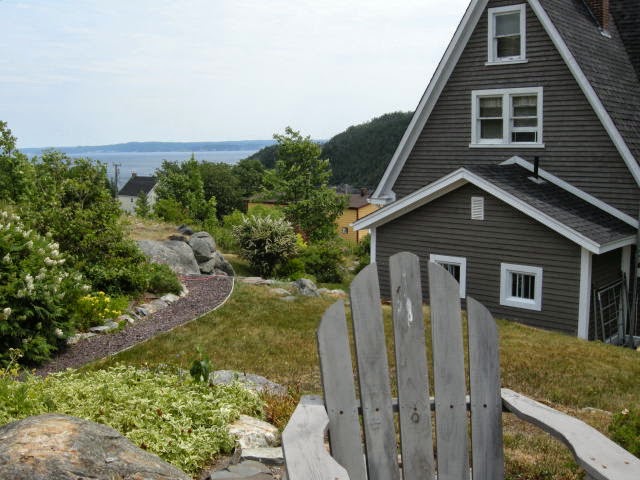
Because the house is on a high hill you have a great veiw of King's Cove harbour and several of the houses surrounding it.

I am such a sucker for looking up when I take shots.  This is a big reward.


 When you look up you are greeted by a stunningly refurbished house. The two patios provide interesting views of the garden.


Another bed of perennials creeps up the hill toward the back of the house to a third sitting area just outside the back door. Aren't the variety of stone walls interesting? Here's a closer look.....


 Following a stone path beyond will bring you to the fourth seating area at the top of a hill behind the house.  This provides a totally different feel and view of the whole area.


 You can look right out the bay as far as the eye can see.  The houses beside the property actually become part of the composition of the garden.  How great is it to have a yellow  building with  red trim next to your property!  It is such a strong focal point and  it adds additional colour when the blooms disappear. .


While heading down the path again, I was treated to a close up view of  numerous butterflies sailing around a false spirea. 
 

Thank you Veronica and Kevin for allowing us to visit your garden.  


5 garden planning tips  from this garden visit:
  1. Consider  what lies beyond your garden and use it to advantage.  It might not be yours, but it can be part of your composition. 
  2. Use meandering paths to connect different parts of your space, and use the same treatment for all of them: crushed stone, brick, slate etc. This continuity adds cohesiveness to the composition.
  3. Always keep parts of your garden hidden from view and lead the visitor to them by using meandering paths and plantings. 
  4. Have several seating areas to provide choice during different parts to the day or  to provide different viewing vantage points. 
  5. Have a strong mix of flowering shrubs and perennials if you want to be a carefree gardener. 

Rabu, 25 Juni 2014

Thoughts on choosing dark kitchen cabinets

 Questions  about the wisdom of  choosing dark  kitchen cabinets keep cropping up in my reading and client discussions. Of course there are no absolutes in decorating.  You can make anything work or look good if you have the skills, and using dark cabinets in any room  requires a deft hand.

If you want your dark cabinet choice to work and have the longest style staying power, consider the following:

Let the cabinets shine


dark cabinets high contrast

 When I work with clients who want everything that they consider trendy in one space, I always discuss the wisdom of this approach.   Something has to be the star in a space and you should decide in the beginning what the star will be.  When you choose dark cabinets they demand centre stage, and everything else should support them and make them look their best.  Using lots of white or very light colours with dark cabinets is the way to go to get that sophisticated, rich, classy look that many people are after when they choose dark cabinets.  

Use  in open area spaces


dark cabinets open concept

Dark cabinets work well in large, open area spaces where the wall colours are lighter rather than darker. The dark cabinets help to balance and ground the space. .

Have breaks in the dark flow


open spaces with dark kitchen cabinets


 Leaving lots of wall space free of cabinets and/or having glass with light interior cabinets can do a  lot to balance a darker cabinet colour.  Having contrast with the floor is a must to create a lively space.

Mix dark and light together


mixing light and dark kitchen cabinets

 If you are afraid of too much dark but like the look why not do a mix of darks and lights together? 

Questions to consider: 


 Is there enough contrast with the floor? 

dark kitchen cabinets dark floors

When you choose dark cabinets your floors need to contrast with the cabinets or you are going to have the "bear cave" look that happens when your floors blend in with your cabinets. This is not an attractive look for  smaller spaces.    Even thought the floor above does have some contrast with the cabinets, I would have chosen something a tad lighter to open up the space.  Again, no absolutes, only considerations and photos often lie.  This is a lovely space.

 Is there enough contrast between elements?

dark kitchen cabinets contrast

This space is unusually dark.  It is the perfect kitchen for someone, but I would venture to say that it would not be a selling point for many buyers.


Can you have too much  pattern?

patterned countertop and backsplash

  When you have darker, busy countertops  and then have patterned backsplash you are setting up pattern competition, and it can look very busy in a small space. My rule of thumb is patterned counter, plain backsplash.

Do you have enough lighting?

adequate kitchen lighting dark cabinets


Sometimes it is difficult to tell from a photo exactly how much light is in a space.  This space is reading dark even with the obviously adequate lighting from three (probably four with under counter) light sources and light reflection from the white counter and backsplash.

Who knew there was so much to consider when you decide to go for dark!  Again, there are no absolutes only considerations and balances.   Happy decision making.

Rabu, 11 Juni 2014

5 Tips for painitng small spaces

 The one topic I've written about on my blog that gets attention from thousands of decor happy readers is decorating small spaces.  I think that is because rooms and homes today are smaller than they once were.  People living in condos or apartments must be conscious of using every trick in the book to enlarge their living spaces. So stay awhile and see how colour can solve some of your small space dilemmas.  Perhaps in these suggestions you will find a treatment for your small space.


Use one colour everywhere


This might seem like an extreme solution but it isn't really.  Using one colour all over a room makes the different planes blend together  to give a more unified look.  You can even use the same colour on the floor and ceiling if you wish.  Since your eye continues to move  freely around the room you have no sense of the boundaries of it.

same colour on walls and ceiling bedroom

If I could change one thing about this room above, I would paint the trim a soft pink too to keep the eye moving. Painting  trim white creates vertical and horizontal lines that your eyes automatically go to and follow. You can see the difference in the room below where the trim is painted out.  The room has an unbroken field of colour that is certainly expansive even though a dark colour was used.


painting trim and walls same colour


source

More blue, but the trim is painted a coordinating colour that is closer in value to the walls decreasing the emphasis on  the trim which seems to just blend in.

dark colours in small living room

Use cool colours 


 The rooms above are using the same colour almost everywhere, but they  are also utilizing another colour trick. Cool colours like blues, blue grays etc. make the walls of a room recede thus making the space appear larger than it actually is. Blues are an excellent choice for small bathrooms, laundry rooms, spare bedrooms, etc.  When walls recede you tend to notice the furnishings rather than the  "box" that contains them.

There's nothing like a cool lavender with white and light grays to expand a space.  
 

dark walls small living room

Use a dark colour on the walls


That's right, a dark colour!  Would you ever think that would work?  It does because  the corners disappear in the shadows and your eye moves around easily. Darker colours are often perceived as  visually deeper. There are  decorators who take the opposite approach to keeping walls light in a small space.  And the final trick with dark colours in small rooms is to paint them in a semi-gloss or gloss to reflect light.  This approach is not for the faint of heart,  but it can be quite stunning.   If you're afraid to go really dark choose a mid value gray or taupe.


Use a colour you see outside


Blues and greens give the impression that the room continues beyond the windows. You can paint the walls an outside colour or use one  in your fabric choices.  I love the freshness of the room below. It certainly is reminiscent of  plants.


blue and green living room


blending outside and inside colours

Designer Christina Murphy uses green to great effect  to visually extend this room by connecting it to the view outside the window.  Keeping a simple colour scheme is also visually enlarging.


blending outside and inside in decor 

Everything about this room invites the outside in and blends the two together. Lighter floors always enlarge a space.  There are no dark hardwoods in my life, I like light and airy all the way.

Keep walls and furniture a similar colour 


 When you keep the furniture and walls close to the same colour you are blurring the lines between them. As a result the mass of the furniture is decreased and the overall volume of the room is increased.  If you don't wish to have all the furniture the same colour consider having at least  the bigger items like armoires and chests close to the wall colour so they will begin to blend into the room and widen it out.


Decor by Jennifer Inc contemporary family room

I also want the cabinet for the TV to be a lighter colour, but it is undeniably a focal point in the room  and every room needs one. I'd also skip the dark wood rods which your eye travels to automatically because of the contrast, but I also understand why the decorator chose them (all the woods in the room are dark).   Overall I love these two rooms.  They are warm and inviting.

Alexandru Apartment lviing room contemporary living room

I equally love the cool minimal look  of this room, but it isn't for everyone.

Paint a Focal Wall


 I'm not a large fan of painting a focal wall.  I think sometimes it works to great advantage, but most times it is a less than creative solution in a space. This strategy  can work wonders in a small space, Don't be afraid to paint an accent wall a darker receding color thus  making the space look larger.


Living Room  dark focal wall

 And there you have it.  The only thing left to do is decide which of these solutions will work in your space. 
 Happy painting.